
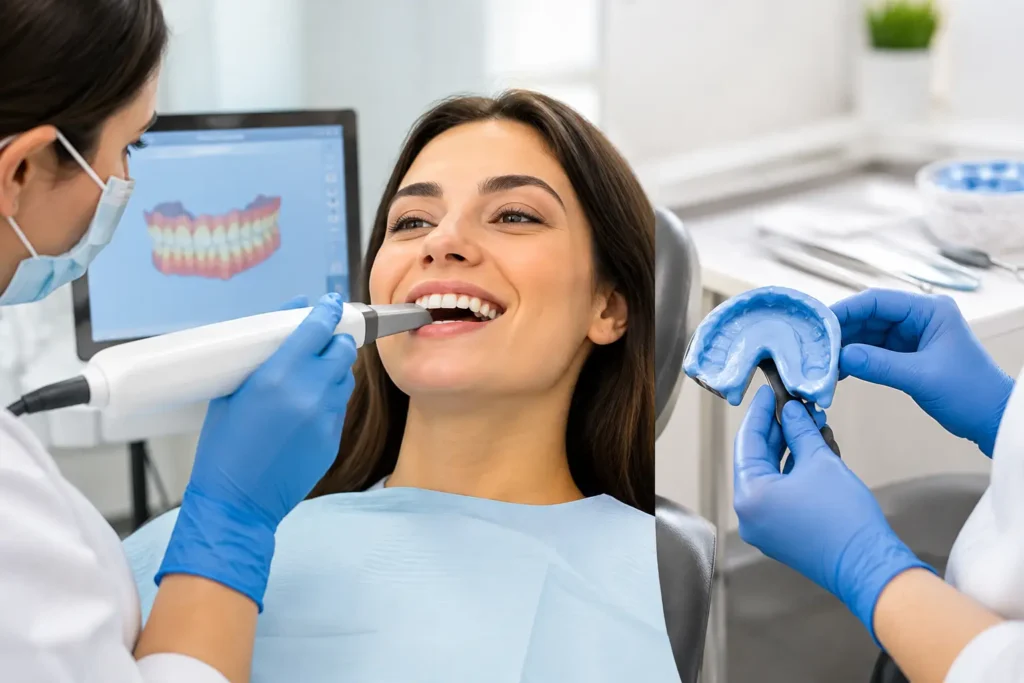
A dental impression used to mean a tray filled with thick material, a few minutes of holding still, and sometimes a strong gag reflex. For many patients, that experience is the first thing they picture when a dentist mentions a crown, bridge, night guard, or aligners. With digital scans vs impressions, there is now another option: a small camera that captures a detailed 3D image of your teeth.
Both methods can play an important role in quality dental care. The right choice depends on the treatment you need, the condition of your teeth and gums, and what will provide the most accurate result. Understanding the difference can help you feel more prepared before your appointment.
What Is a Digital Dental Scan?
A digital dental scan uses an intraoral scanner, a handheld device that takes thousands of images of your teeth, gums, and bite. Those images are combined into a detailed 3D model on a computer screen. Your dentist can review the model right away, rotate it, enlarge specific areas, and check how your upper and lower teeth come together.
The scanning tip is moved gently around your mouth. There is no putty-like material, no bulky tray, and usually no need to wait with your mouth open while an impression sets. If a small area is missed, the dentist can often rescan only that section instead of starting over.
Digital scans are commonly used for crowns, bridges, veneers, clear aligners, retainers, night guards, dentures, and treatment planning. They can also help patients see what their dentist sees. Looking at a 3D image of a cracked tooth, worn edges, or crowded teeth can make a treatment recommendation easier to understand.
What Are Traditional Dental Impressions?
Traditional impressions use a tray and dental material to create a physical mold of your teeth. The material is placed in the tray, positioned over the teeth, and left in place until it sets. That mold is then used to create a model or is sent to a dental laboratory.
This technique has been used successfully for decades. A well-taken conventional impression can provide excellent detail, particularly when it is completed carefully and used for the right situation. Traditional impressions remain a valuable tool, not an outdated shortcut.
Some treatments or clinical conditions may call for a conventional impression. For example, certain full-arch cases, complex denture work, or areas where moisture control is difficult may benefit from a specific impression material or technique. Your dentist should choose the method based on accuracy and your needs, not simply because one approach is newer.
Digital Scans vs Impressions: Comfort Matters
For patients who feel anxious at the dentist, comfort can be a major factor. Digital scanning is often easier for people with a sensitive gag reflex, breathing concerns, or discomfort with impression trays. The scanner is small, and you can pause if you need a break.
Traditional impressions can feel unfamiliar, especially when a tray covers the back teeth. Some people notice pressure or a temporary sensation of fullness. Others tolerate them without any issue. If you have had a difficult impression experience before, tell your dental team before treatment begins. There may be practical ways to make the process more comfortable, including using a different tray size, taking breaks, or choosing a digital option when appropriate.
Children and adults who find it hard to stay still may also prefer scanning. The process is interactive, and the image appears on screen as it is being captured. That said, a scan still requires cooperation. Keeping your mouth open and following instructions helps the team capture a complete, accurate image.
Accuracy and Fit: The Real Priority
Comfort is valuable, but fit is what protects your oral health and your investment in treatment. A crown that does not fit properly can allow bacteria to collect around its edges, affect your bite, or lead to sensitivity. A night guard that is inaccurate may be uncomfortable enough that you stop wearing it. Whether your dentist uses a scan or an impression, the final goal is a restoration or appliance that fits precisely.
Digital scans can offer highly detailed images and reduce some issues associated with physical materials, such as distortion during removal or shipping. They also allow the dentist to review the scan immediately. If the margins of a prepared tooth are not clear enough, adjustments can be made while you are still in the chair.
However, technology does not replace clinical skill. Moisture, bleeding gums, deep tooth margins, patient movement, and complex bite relationships can affect any record-taking method. A skilled dentist knows when a digital scan is ideal and when a traditional impression may better serve the case.
How Each Option Can Affect Treatment Time
Digital workflows can reduce steps for some treatments. After a scan is completed, the file can be sent electronically to a dental laboratory or used to design an appliance. This may make communication clearer and avoid delays related to transporting physical molds.
A scan also makes it easier to store your dental records. If you need a replacement retainer or night guard later, the digital file may be available for the dental team to reference. Whether a new appliance can be made without another visit depends on the treatment, your oral changes over time, and the dental laboratory’s requirements.
Traditional impressions may take a little more chair time because the material needs to set, and the physical mold must be handled carefully. Still, they do not automatically mean a long or inconvenient process. The overall timeline for a crown, aligner case, or denture depends on many factors, including laboratory turnaround, tooth preparation, healing, insurance approval, and the complexity of your treatment.
Which Treatments Work Well With Digital Scans?
Digital scans are especially useful for many common restorative and cosmetic procedures. They can support the planning of custom crowns, bridges, veneers, clear aligners, retainers, sports guards, and night guards. They are also helpful when evaluating tooth wear or comparing changes in tooth position over time.
For smile-focused care, a 3D scan gives patients a clear look at their current smile before moving forward with treatment. This can support better conversations about spacing, crowding, uneven edges, worn teeth, or the shape of a planned restoration. It is not a guarantee of a final cosmetic result, but it is a useful planning tool.
At South Zone Dental, advanced technology is part of a patient-first approach to care. The goal is not to use technology for its own sake. It is to make visits more comfortable, explain treatment clearly, and help deliver results that feel and function naturally.
Cost and Insurance Considerations
Patients often assume digital scanning costs more. Sometimes the method is included as part of the treatment fee, and sometimes pricing varies based on the procedure and materials involved. The bigger cost consideration is usually the treatment itself, such as a crown, denture, aligner plan, or custom appliance, rather than the record-taking method alone.
Insurance coverage also depends on your specific plan and the reason for treatment. A dental team can help explain estimated costs before care begins, but final coverage decisions are made by the insurance provider. If affordability is a concern, ask about the expected treatment fee, what your plan may cover, and available payment options before starting.
How to Know Which One Is Right for You
The best question is not, “Are digital scans better than impressions?” It is, “Which method gives me the best result for this treatment?” For a straightforward crown or retainer, a digital scan may offer excellent accuracy with greater comfort. For a more complex case, your dentist may recommend a traditional impression, a digital scan, or even a combination of records.
Share anything that could affect your visit: a sensitive gag reflex, dental anxiety, jaw pain, difficulty breathing through your nose, or a past issue with a crown, denture, or appliance. These details help your dental team tailor the experience and select the most appropriate method.
Modern dental care should feel clear, comfortable, and focused on you. Whether your treatment begins with a digital scan or a traditional impression, a careful record is the first step toward a healthier bite, a better-fitting restoration, and a smile you can feel confident sharing.